
Executive Summary
Led product management for HomeLuv, a strategic initiative born from the Innovator’s Dilemma—finding a new model to compete before the existing cash cow gets disrupted. While Builder Homesite’s NewHomeSource dominated the SEO-driven home search market, HomeLuv took a fundamentally different approach: visual-first discovery based on what homebuyers love, not traditional checkbox search. Over two years, built a consumer platform that achieved stickiness goals by engaging homebuyers earlier in their journey than any competitor.
The Innovator’s Dilemma
Builder Homesite had a successful cash cow: NewHomeSource, an SEO powerhouse that captured homebuyers actively searching for new construction. But the company recognized a classic innovator’s dilemma: competitors like Houzz and Zillow were also competing for the same SEO-driven traffic, and the cost of competing was rising.
More importantly, the SEO play only captured the 3% of the market ready to buy now. The other 97%—people dreaming about homes, experiencing discontent with their current living situation, or casually researching—went to Pinterest, Houzz, or nowhere at all.
HomeLuv was the answer: a separate product line designed to find a different model to compete—one that could eventually become the new growth engine if/when the SEO model became commoditized.
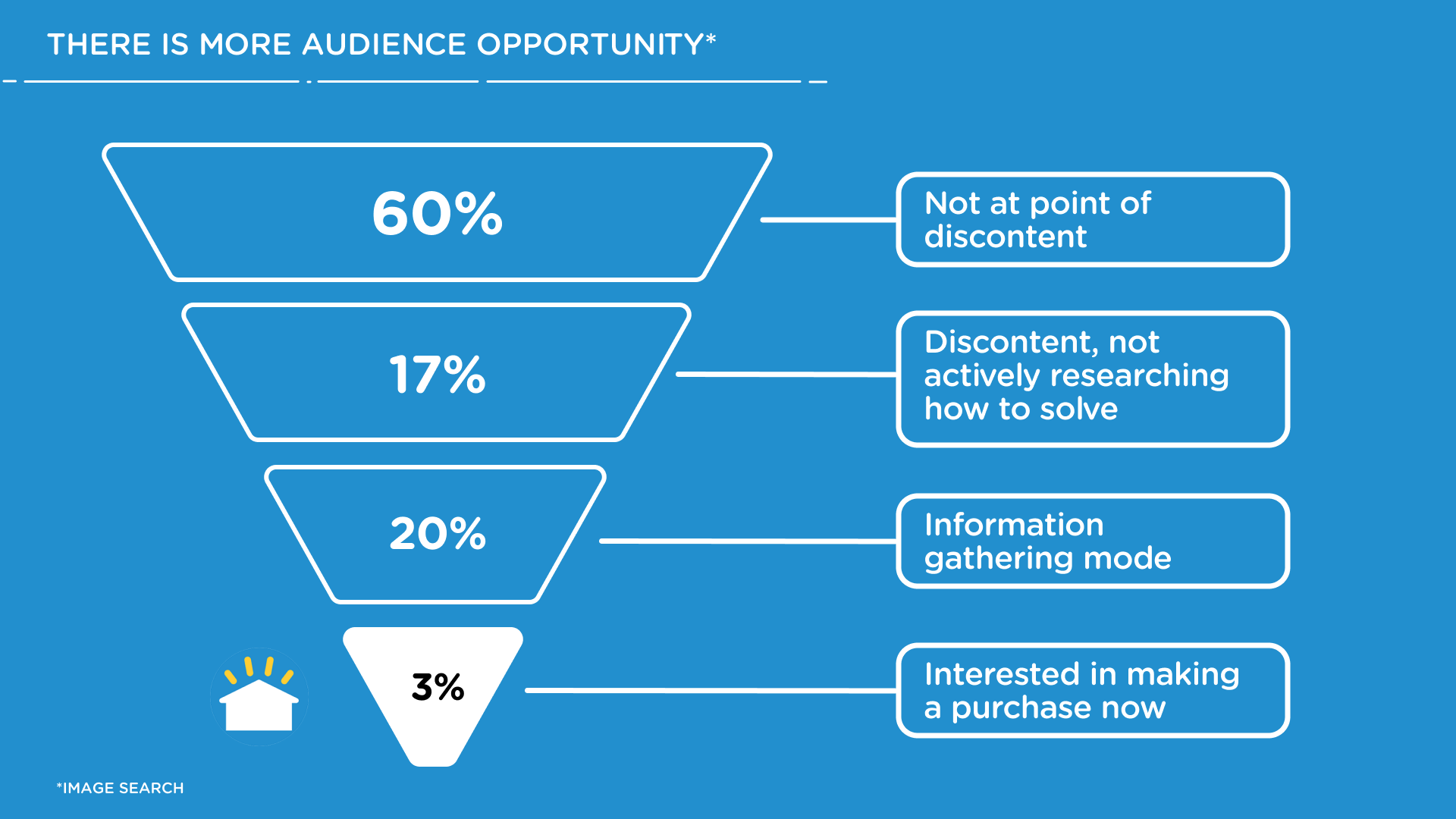 The Audience Opportunity: 97% of potential homebuyers aren’t ready to purchase—yet
The Vision
‘What if buying a new home worked the same way our hearts and minds do? Based on what we need, what we love, and what appeals to us the most?’
HomeLuv’s core insight: traditional home search is broken. Checkbox filters (3 bed, 2 bath, 2000 sqft) don’t capture what makes people fall in love with a home. Who cares if you have enough bedrooms if you hate everything about the house?
The 3-year vision: give home dreamers a single place to be inspired, plan for, personalize, and love their homes. Match.com for homes—based on visual preferences, not checkboxes.
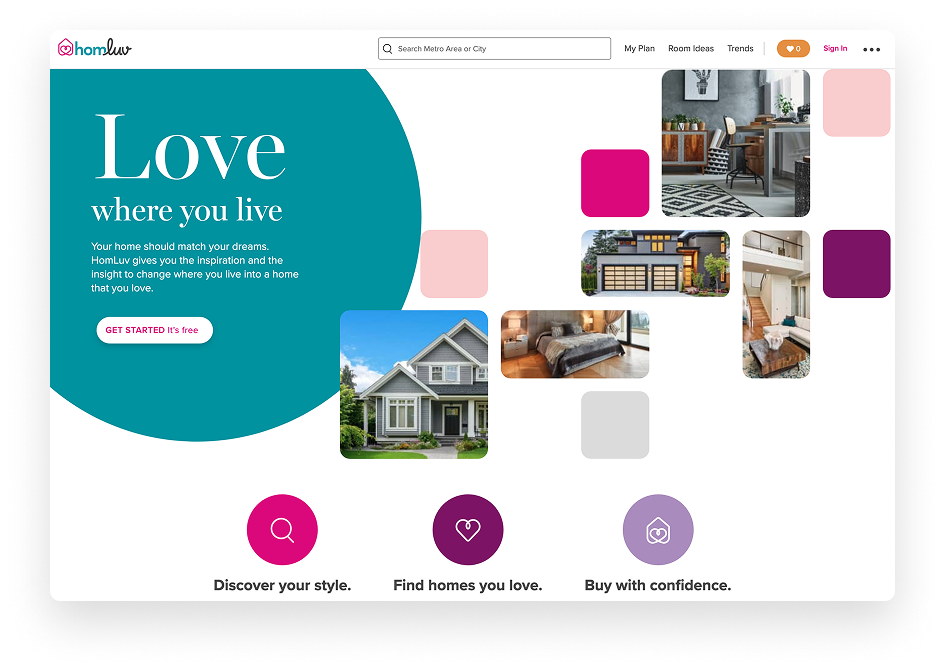 HomeLuv: “Love where you live” — Discover your style, find homes you love, buy with confidence
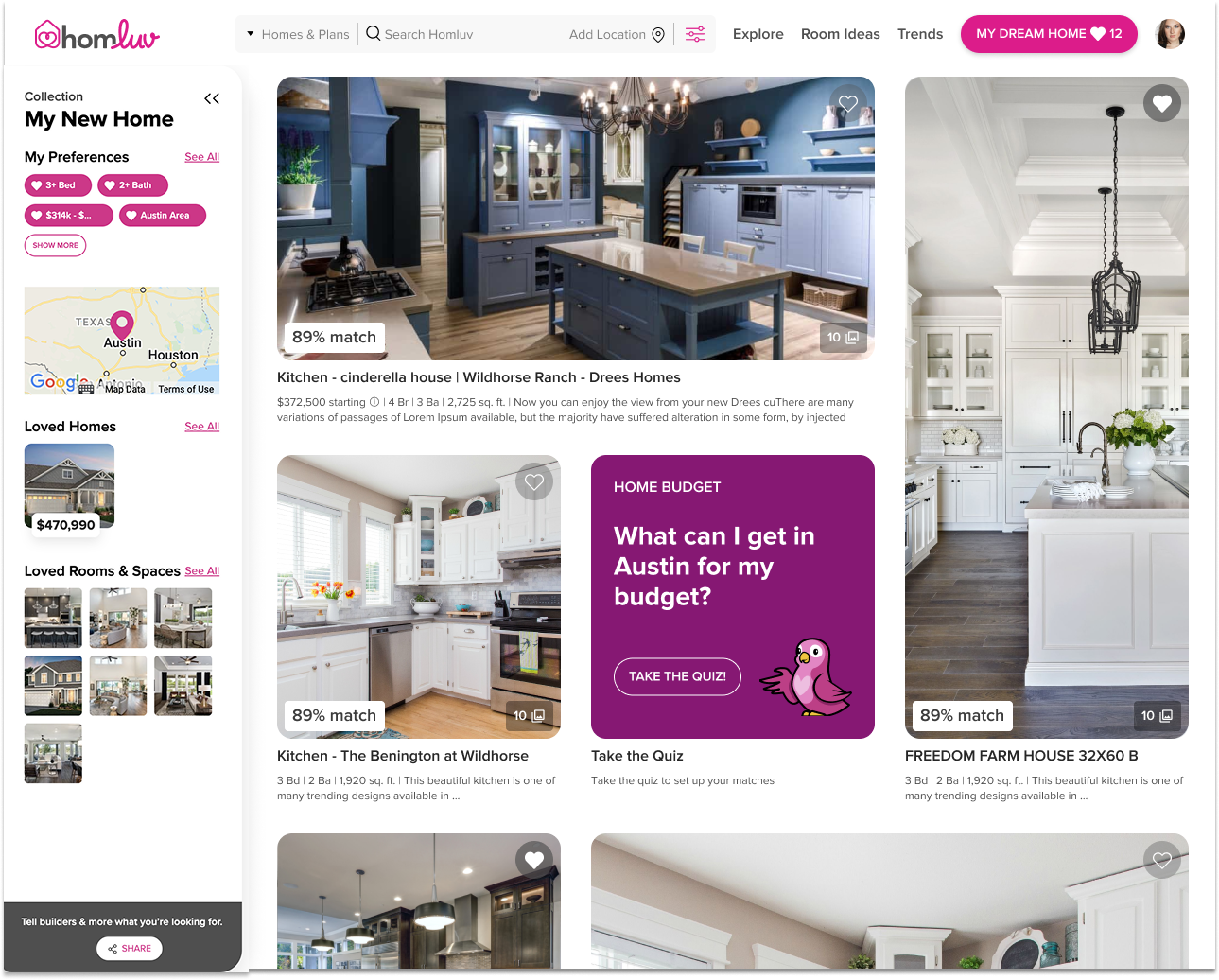 HomeLuv: Build your profile by loving what you see
Four Pillars Framework
I structured the product strategy around four pillars that mapped to the homebuyer journey:
INSPIRE - Drive the visual/emotional connection. High-quality images, items that inspire, collaboration and sharing.
EDUCATE - Onboard to visual search. What’s out there? Why new construction? What can I afford?
MOTIVATE - Gamification, progress tracking, excitement of getting a home match. Keep them coming back.
EMPOWER - Pre-qualification help, visualization tools, guided steps through the buying process.
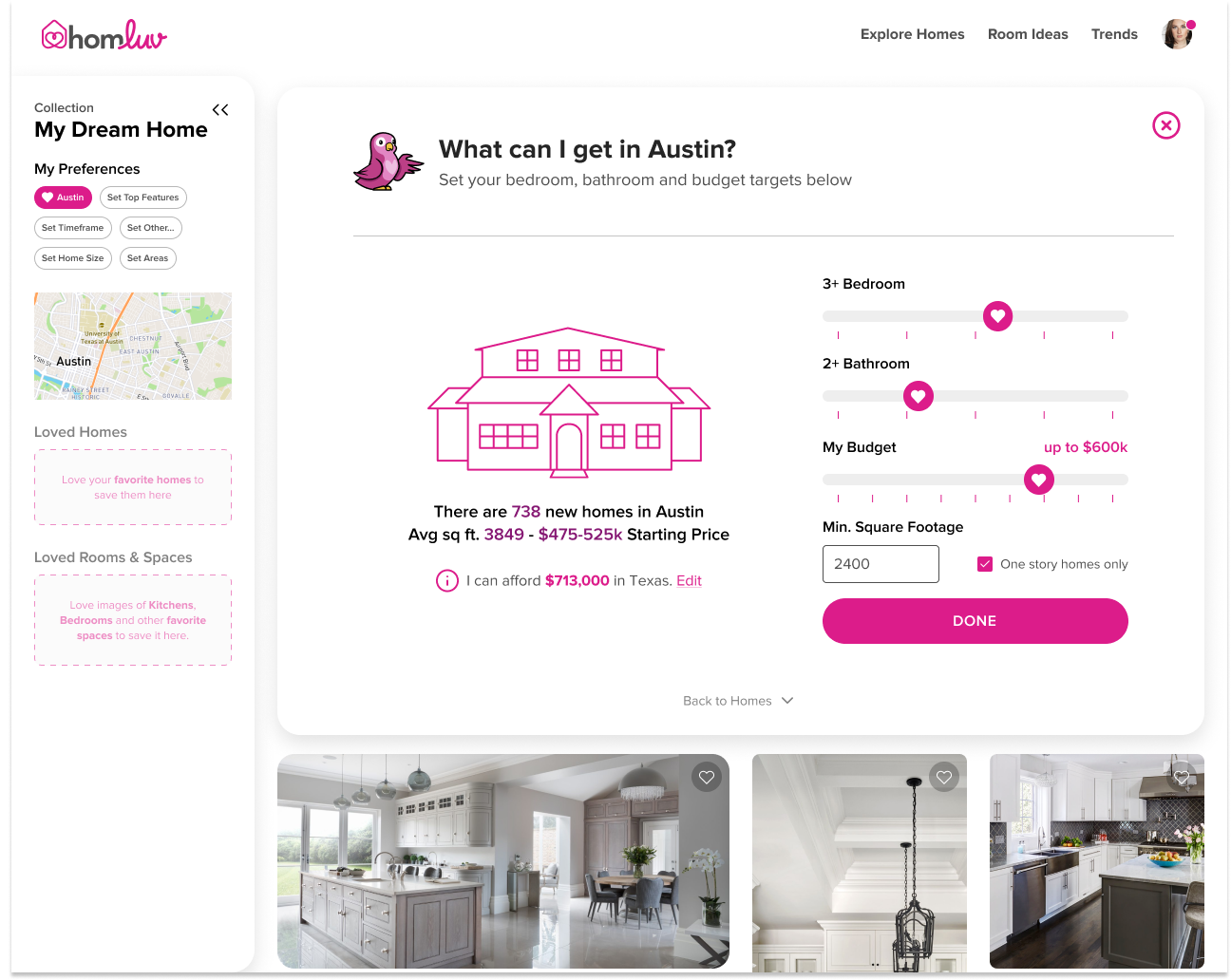 Defining your core constraints to narrow your search
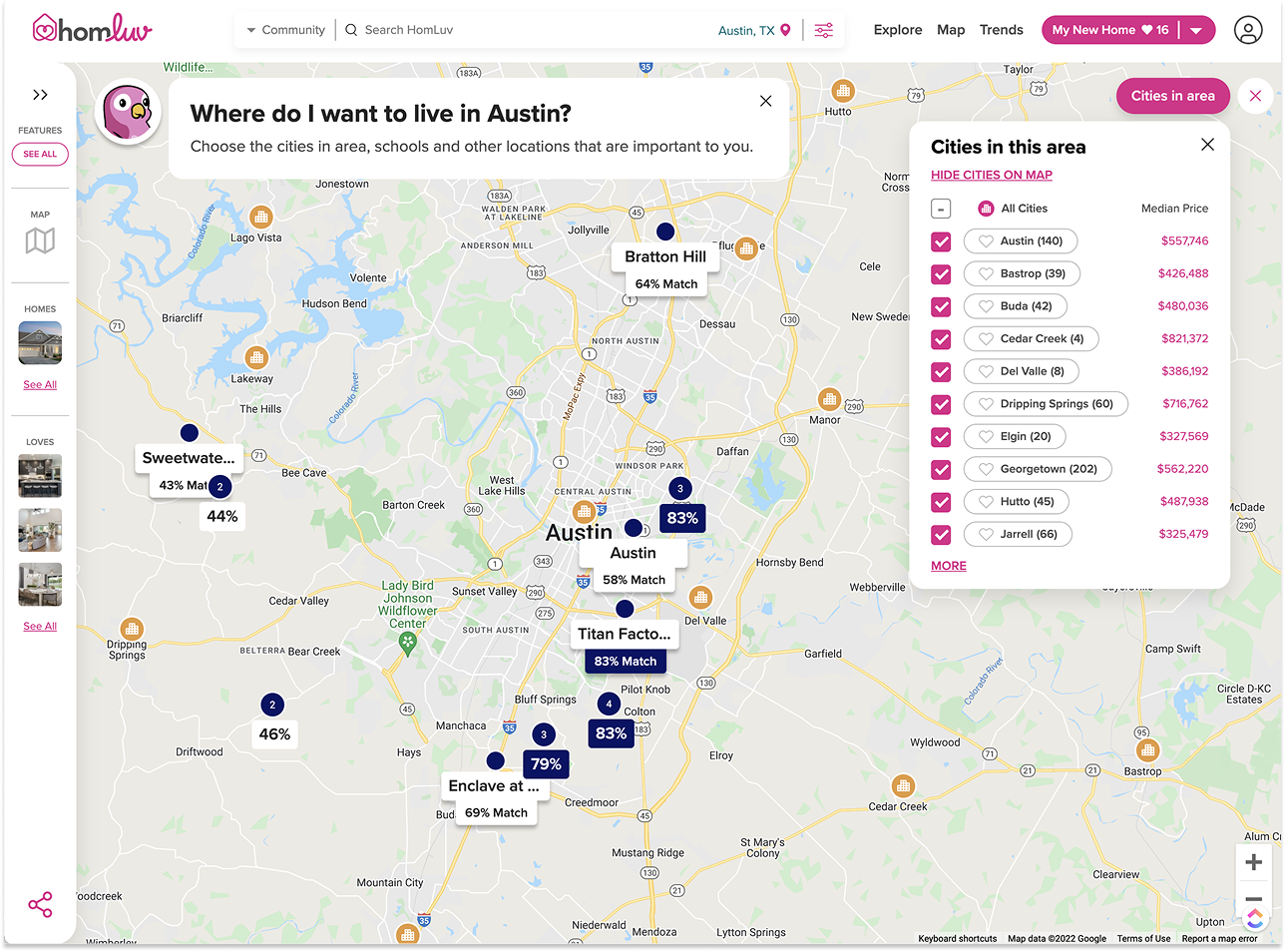 Defining your goal areas
LuvLingo: Your Style Profile
The core mechanic: as users ‘Luv’ images, the system built a style profile (‘LuvLingo’) that captured their preferences across rooms, features, and design styles. This profile then powered personalized home recommendations.
User profiles connected to multiple discovery surfaces:
- ‘Your Luvs’ — room-by-room preference breakdown with feature and style analysis
- ‘Dream Home Recommendations’ — homes matched to visual preferences, not just checkbox criteria
- ‘Vision Boards’ — curated collections for different projects (‘My Austin Home’, ‘Kitchen Remodel’)
- ‘Your Brands’ — favorite home builders, designers, and craftsmen based on loved content
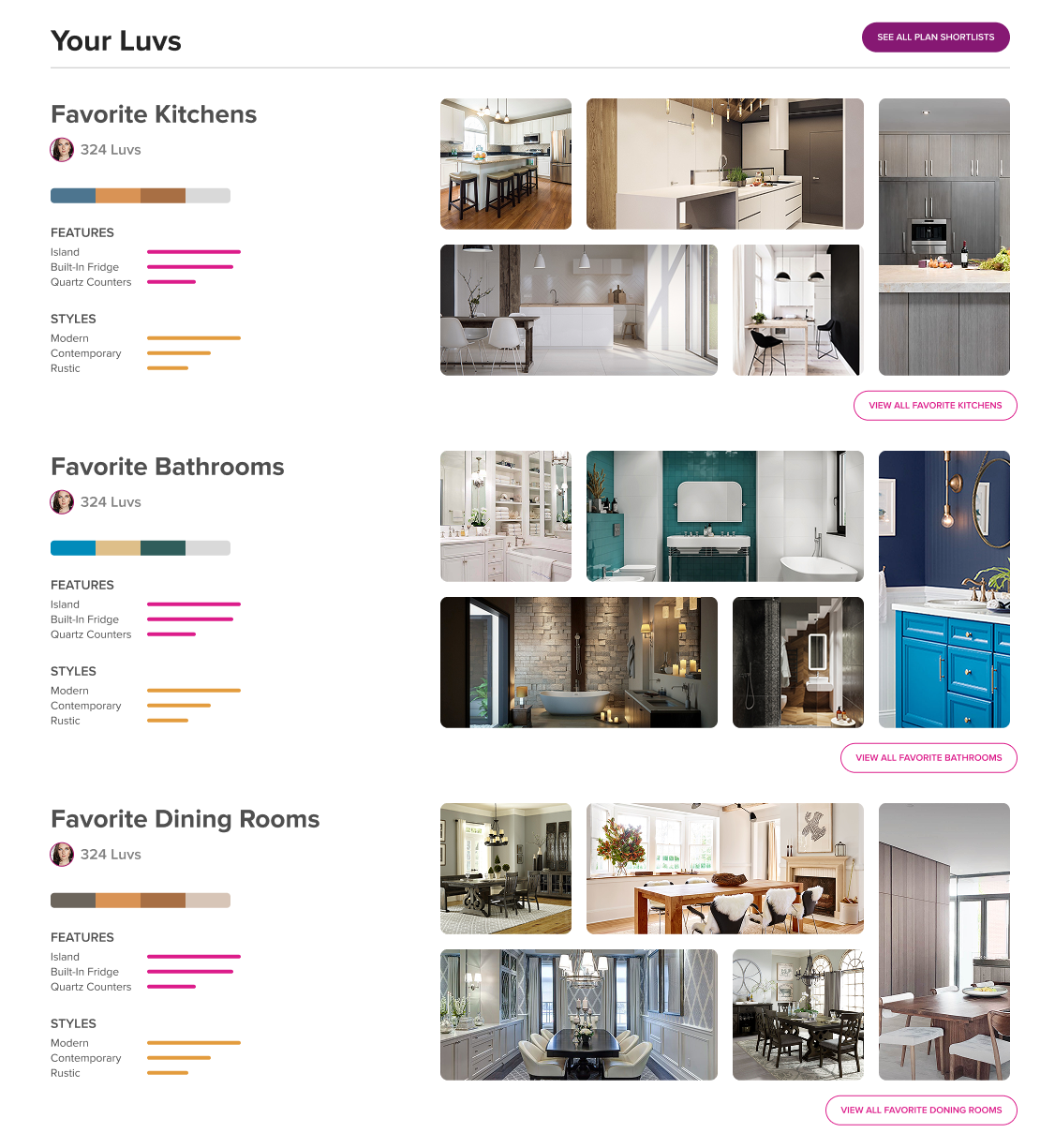 *Personalized Discovery: Room favorites with feature analysis *
Profile-Powered Search
The user profile became the foundation for a fundamentally different search experience. Instead of starting with filters, users started with inspiration—and the system surfaced homes that matched their visual preferences.
The platform showed:
- Number of loved images (e.g., 4,503)
- Match percentage with search criteria (e.g., ‘You’ve seen 48% of your house matches’)
- Recent searches and saved homes
- Dream home recommendations
- Plan shortlists for different projects
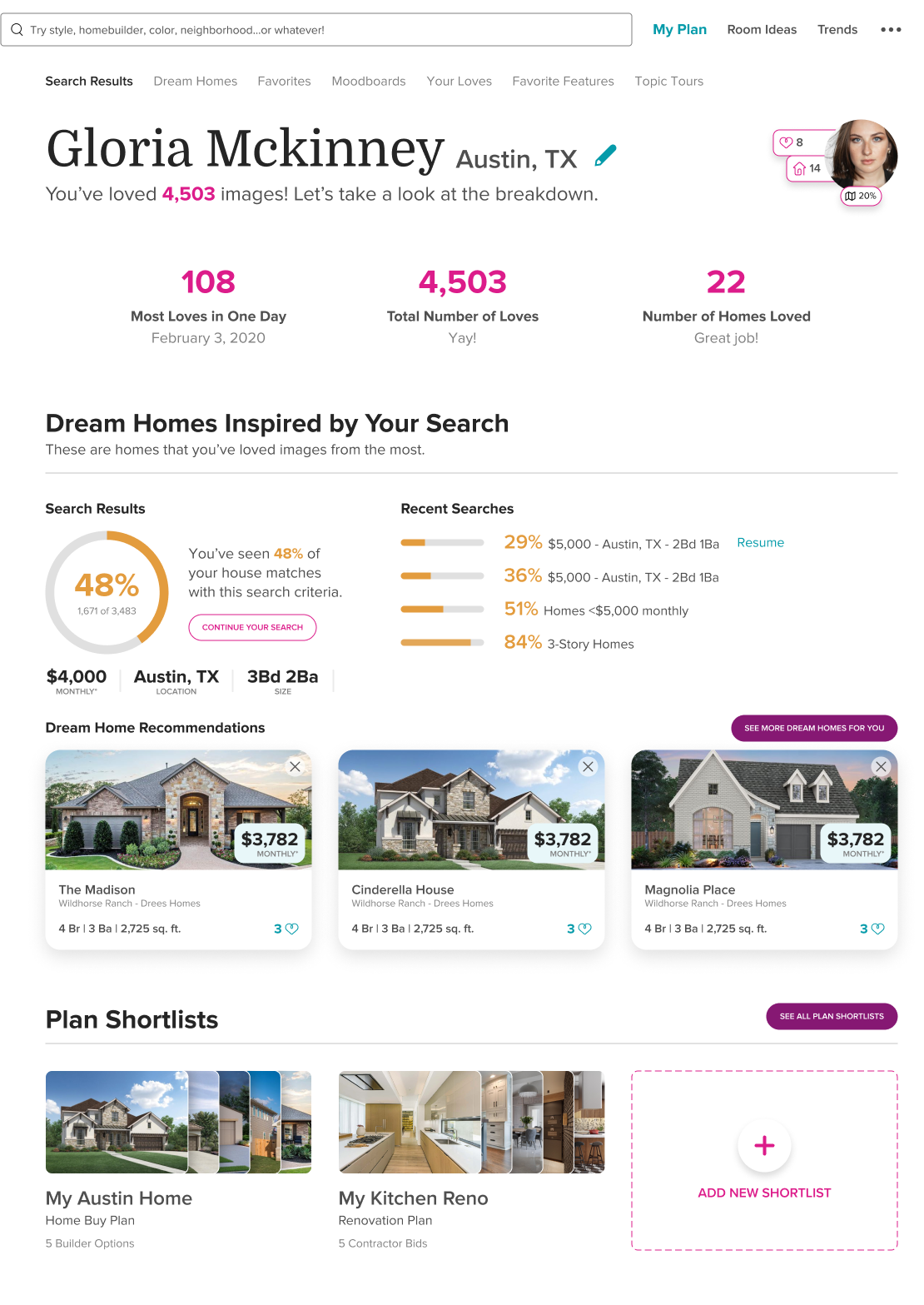 Profile-Powered Discovery: 4,503 loved images → Dream home recommendations matched to preferences
The Growth Model
The strategic model prioritized stickiness before scale—a deliberate choice to avoid the trap of spending on paid acquisition before product-market fit:
- Build stickiness: Time-on-site, return visitors, engagement depth (actions per visit, boards created)
- Prove the network effect: Dreamers who love the product start driving independent traffic through sharing
- Then scale: Paid traffic and SEO efforts switched on to accelerate, avoiding expense too early
This was intentionally different from NewHomeSource’s model—and that was the point. The goal was to find a different way to win, not to compete for the same traffic.
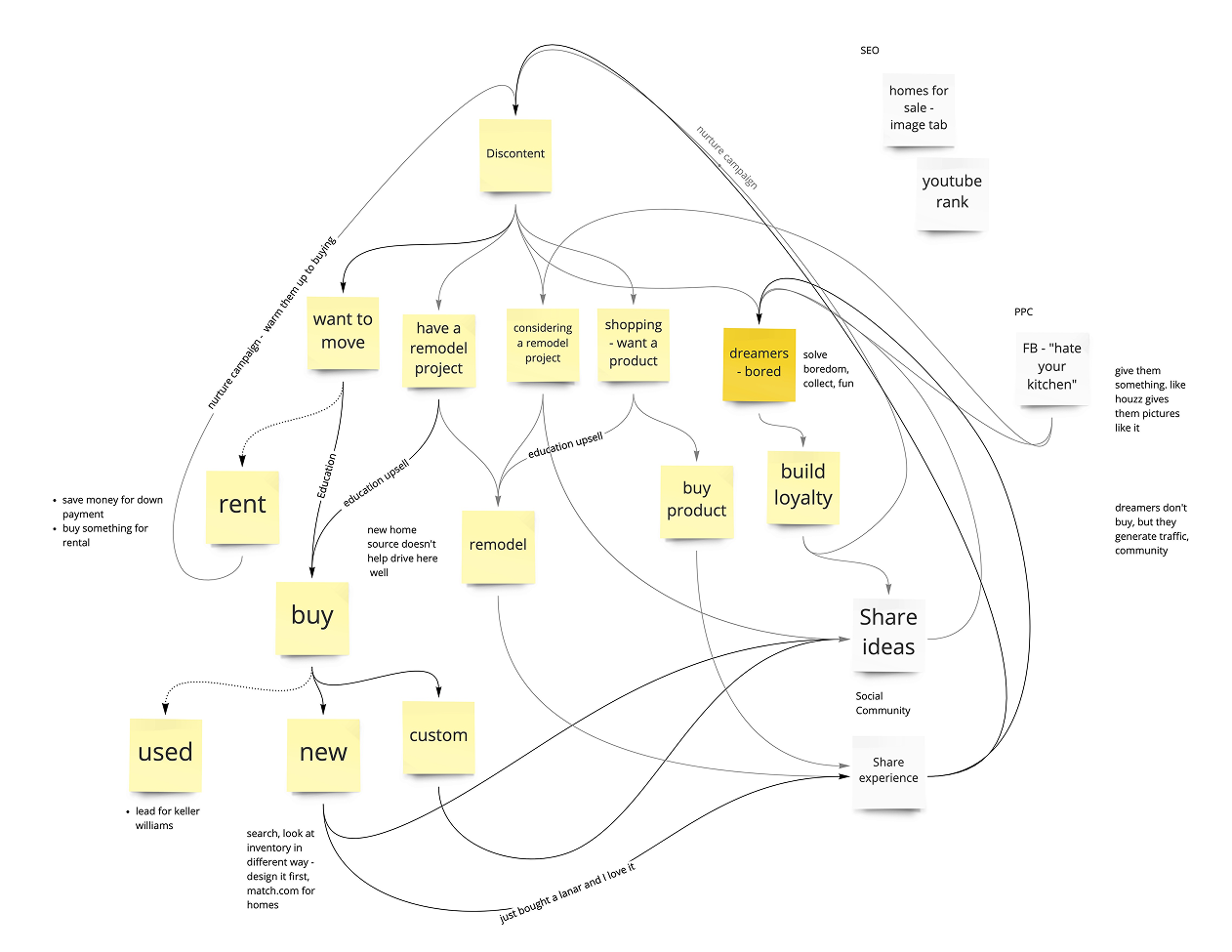 The HomeLuv Model: Sticky site → Dreamers drive organic traffic → Then paid/SEO to scale
Results
Outcomes
- Achieved stickiness goals — time-on-site and return visitor metrics hit targets before organizational changes
- Validated the visual-first approach — users engaged with the ‘Luv’ mechanic and built meaningful style profiles
- Proved alternative engagement model — demonstrated that homebuyers would engage earlier in journey through inspiration
- Strategic asset created — HomeLuv was eventually sold as a separate business after organizational changes
Key Learnings
The Innovator’s Dilemma is real
Successful companies need separate initiatives to find new models before disruption hits the cash cow.
Compete differently, not harder
Rather than fighting for the same 3% of ready-to-buy traffic, engage the 97% earlier with a fundamentally different value proposition.
Stickiness before scale
Resist the pressure to spend on acquisition before product-market fit. Prove engagement depth first.
Emotion drives discovery
Checkbox search captures what people can articulate. Visual discovery captures what they actually want.
Why This Matters
This case study demonstrates strategic product leadership—not just building features, but positioning products within a portfolio to create long-term competitive advantage. The ability to recognize when a new model is needed, define the vision for it, and execute while protecting it from the gravitational pull of the cash cow is a critical leadership skill.
The core pattern—engage earlier in the customer journey with a different value proposition—applies across industries. Whether it’s homebuyers, enterprise software purchasers, or manufacturing customers, the insight holds: there’s more opportunity in the 97% not ready to buy than the 3% everyone is fighting for.