
Executive Summary
Led product optimization for NewHomeSource.com, America’s leading online platform for new construction homes. Through audience research, qualitative and quantitative analysis, and extensive A/B testing, we identified what modern homebuyers actually wanted and refined the experience to increase conversions, registrations, and time on site. The work spanned content strategy through final design, demonstrating a research-driven approach to improving an established product.
The Platform
NewHomeSource.com is a dominant force in new construction real estate, connecting buyers with builders, communities, and resources. The platform offers:
- Extensive listings: Tens of thousands of new homes, plans, and communities from trusted builders
- Advanced search: Location, price, beds/baths, community amenities, and builder filtering
- Rich content: Virtual tours, video walkthroughs, interactive floor plans, professional photos
- Buyer resources: Learn Center with articles on financing, design, market trends; TrustBuilder reviews
- Professional tools: Agent-specific info, commission details, and marketing tools for realtors
The platform serves three key audiences: homebuyers actively searching for new construction, builders looking to connect with high-intent buyers, and real estate agents who need tools and data to sell new homes effectively.
The Challenge
NewHomeSource was already a market leader—‘America’s #1 source for new homes.’ But the modern homebuyer’s expectations were evolving. The challenge wasn’t to build something new; it was to understand what today’s homebuyers were actually looking for and optimize the experience to better serve them.
This required a fundamentally different approach than greenfield product development. Instead of defining a vision and building toward it, we needed to listen, test, and iterate—letting data and user research guide decisions rather than assumptions.
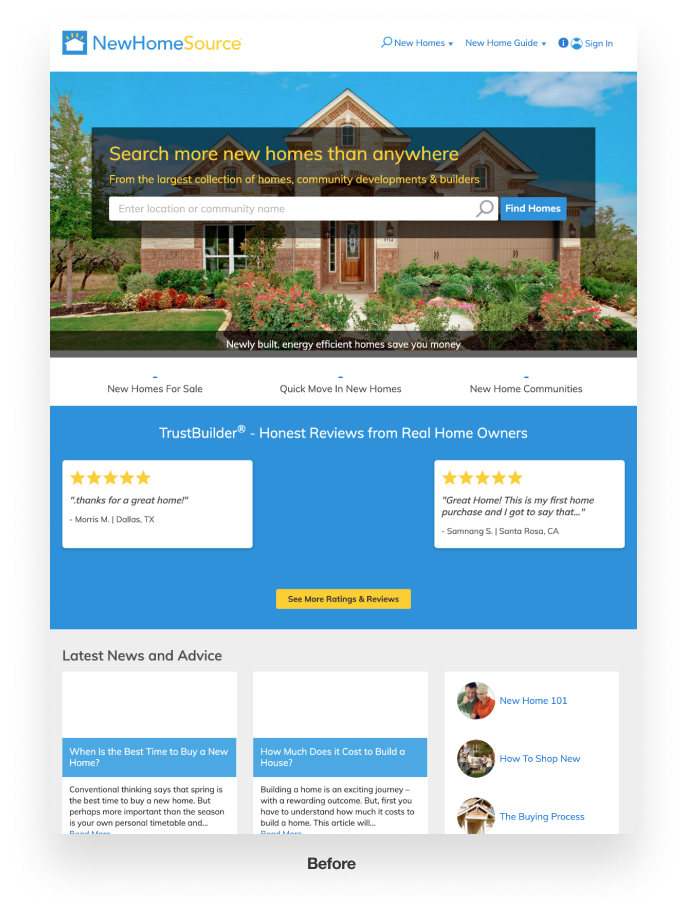 Before: Generic search-focused layout with limited value proposition clarity
The Approach
1. Audience Research We started by understanding who was actually using the platform and what they were trying to accomplish. This meant going beyond analytics to understand motivations, frustrations, and decision-making patterns for different buyer segments—first-time buyers, move-up buyers, those seeking specific features like age-restricted communities or custom homes.
2. Qualitative & Quantitative Analysis We combined behavioral data (what users actually did) with qualitative research (why they did it). Funnel analysis revealed where users dropped off. User interviews revealed why they dropped off. This combination pointed to specific opportunities that neither data source would have revealed alone.
3. Extensive A/B Testing Rather than making sweeping changes based on intuition, we developed hypotheses from our research and tested them systematically. This allowed us to validate improvements before full rollout and build confidence in what actually moved the needle on conversions, registrations, and engagement.
4. Content Strategy Through Design The work wasn’t just about UI changes—it spanned the full stack from content writing to final designs. Messaging, value proposition clarity, visual hierarchy, and interaction patterns all contributed to the improvements.
The Transformation
The before/after comparison illustrates the evolution—from a functional but dated experience to a modern, conversion-optimized design that clearly communicates value at every step.
Key Design Changes:
BEFORE → AFTER
- Generic tagline: ‘Search more new homes than anywhere’ → Clear value prop: ‘The Smartest Way to Buy a New Home’ + ‘America’s #1 source’
- Undifferentiated category links → Local market data: ‘4,732 New Homes For Sale’ in user’s area
- Reviews buried in page → Social proof integrated with clear testimonials
- No guidance on process → ‘Shop, Tour & Buy Online in 5 Easy Steps’ — clear journey mapping
- Content-heavy with competing elements → Clean visual hierarchy guiding user to action
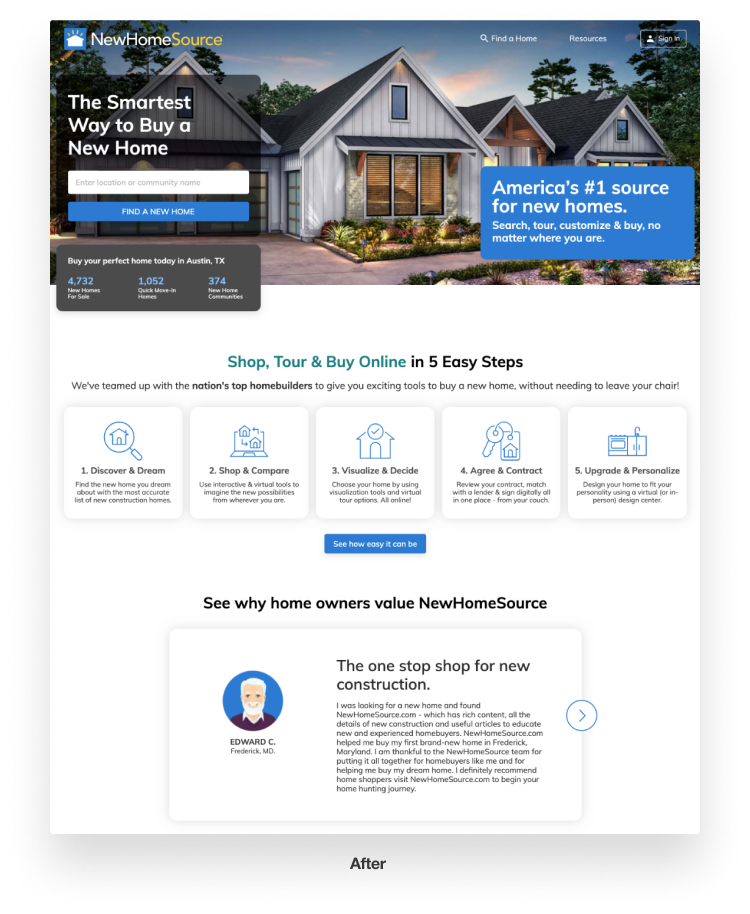 After: Clear value proposition, guided 5-step journey, social proof, and local market data
Results
Measurable Improvements
- Increased conversions: More visitors taking action to connect with builders
- Increased registrations: More users creating accounts to save searches and favorites
- Increased time on site: Deeper engagement with listings, content, and tools
Business Impact
- For a lead-generation platform, conversion rate improvements translate directly to revenue
- Higher engagement meant users were more likely to become leads
- More qualified leads when they did convert
Key Learnings
Optimization requires different muscles than creation
Building something new is about vision; improving something existing is about listening. Both are valuable, but they’re different skills.
Qualitative + quantitative together
Data tells you what’s happening; research tells you why. The best insights come from combining both.
Test before you commit
A/B testing removes ego from the equation. It doesn’t matter what you think will work—it matters what actually works.
Value proposition clarity matters
Users decide in seconds whether a site is for them. Clear positioning—‘The Smartest Way to Buy a New Home’—outperforms generic messaging.
Guide the journey
Showing users the 5-step process gave them confidence and reduced anxiety about a major life decision.
Why This Matters
This case study demonstrates research-driven product optimization—the discipline of improving an existing product through systematic analysis and testing. While greenfield development gets more attention, most product work is actually optimization: making existing products better, faster, more valuable.
The ability to approach an established product with curiosity rather than assumptions, to build hypotheses from data, and to test systematically is essential for any product leader. It’s not about having the best ideas—it’s about having the discipline to validate ideas before committing to them.